
Outdoor Living in Solana Beach: Designing for Ocean Breeze and Salt Air
Outdoor Living in Solana Beach: Designing for Ocean Breeze and Salt Air
Solana Beach sits close enough to the water that the ocean becomes part of the design brief. The light is softer. The air carries salt. Afternoon wind arrives on a schedule most homeowners could set a watch by. A backyard here can feel extraordinary, but only when the design accounts for the conditions instead of ignoring them.
Outdoor living in Solana Beach rewards restraint and precision. The best properties in this pocket of San Diego County are not the busiest ones. They are the ones where every material, plant, and sightline was chosen with the coast in mind.
What Makes a Solana Beach Backyard Different
Three conditions separate a coastal lot from an inland one. The first is wind. The second is salt. The third is lot geometry, since many properties here are narrow, sloped, or oriented toward a view that only opens from one corner.
Inland, a backyard can be designed almost entirely around sun and shade. On the coast, comfort depends just as much on shelter. A beautiful patio that sits in a wind tunnel from three in the afternoon onward will simply go unused. As a result, we start coastal designs by mapping where the air moves before we place a single element.
Designing for Wind Without Closing In the View
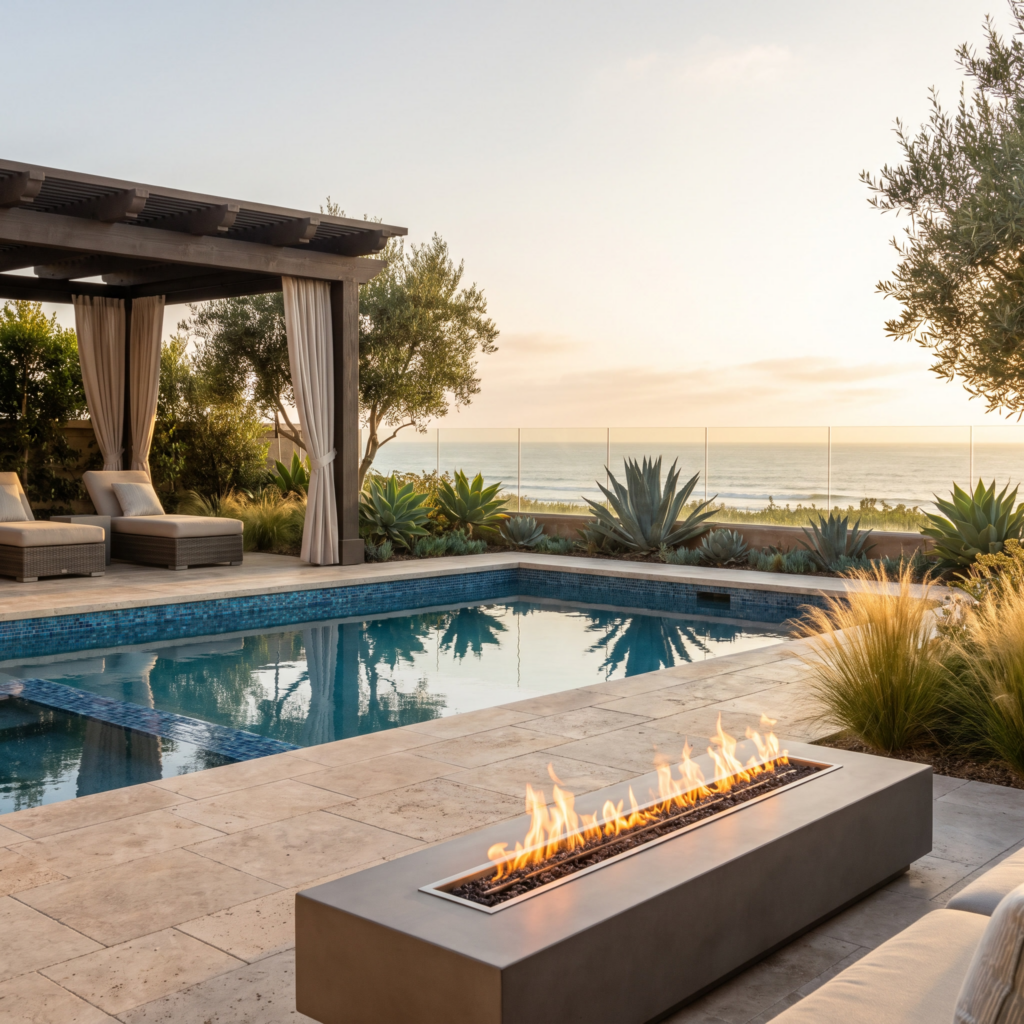
The instinct is to build a wall. The better answer is usually a series of quieter moves. Low glass windscreens block the breeze at seated height while leaving the horizon untouched. A raised planter on the windward edge does similar work with softer lines. In addition, a solid outdoor kitchen island or a fireplace mass can shelter a lounge zone simply by standing in the right place.
Structures help as well. A slatted pergola slows wind while filtering the light, and a cabana with one closed side creates a genuinely calm corner. For example, on several coastal projects we have anchored the seating area behind a fireplace and left the pool side completely open. The result feels protected without feeling enclosed.
Materials That Hold Up to Salt Air
Salt is patient. It finds fasteners, hinges, light fixtures, and anything with an untreated finish. Material selection is where a coastal backyard either ages gracefully or starts looking tired in three years.
We specify 316 marine grade stainless for hardware and outdoor kitchen equipment rather than the more common 304. Powder coated aluminum outperforms steel for pergolas and furniture frames. Porcelain pavers and dense natural stone resist the constant moisture better than softer, more porous options. For lighting, sealed marine rated fixtures are worth the difference, because standard landscape lights near the coast tend to fail early.
Wood still has a place. Ipe, teak, and properly detailed cedar all perform well, provided the design allows air to move behind and beneath them. Trapped moisture is the real enemy, not the ocean itself.
Planting for a Coastal Microclimate
Plants that thrive two miles inland can struggle within sight of the water. Salt spray burns tender foliage, and steady wind pulls moisture from leaves faster than roots replace it. However, the coastal palette is far from limited.
Agave, aloe, westringia, rosemary, sea lavender, and coastal rosemary all hold their form in wind. Olive trees and Podocarpus give height and screening without fighting the conditions. Layering matters too, since a tougher outer row shelters the softer planting behind it. If you want a fuller view of what works across the county, our guide to choosing plants that thrive in a San Diego backyard covers the inland comparison as well.
Pools and Water Features Near the Coast
A pool near the ocean loses heat faster, mostly to wind rather than air temperature. Therefore we plan heating and shelter together. A windbreak on the prevailing side can do more for water temperature than an upsized heater.
Finishes deserve the same attention. Glass tile and high quality pebble finishes handle coastal chemistry well, and a slightly deeper waterline tile band protects the finish where evaporation is heaviest. Sheer descents and scuppers still read beautifully here, though narrow spillways can scatter in strong wind. Broader, lower water features hold their shape. Many of the same principles apply a few miles north, which we covered in our guide to coastal luxury outdoor living in La Jolla.
Layout: Where the Living Actually Happens
Coastal lots often push everything toward the view. That is a mistake when the view side is also the wind side. A better layout gives you two distinct zones. One opens fully to the horizon for morning coffee and sunset. The other sits sheltered, with fire and shade, for the hours when the breeze picks up.
Circulation should feel effortless between them. Wide, level paths, generous steps, and a single consistent paving material keep a compact coastal yard reading as one space rather than several small ones. Budget planning follows similar logic along this stretch of coast, and our breakdown of what a luxury backyard costs in Del Mar is a useful reference point.
If you are planning a backyard in Solana Beach, we would be glad to walk the property with you and show you the design before anything is committed. You can reach us at everlastingpl.com or (858) 250-3233.
Follow our work in Google Search.