
How a Luxury Pool Design Comes Together From First Sketch to Final Tile
How a Luxury Pool Design Comes Together From First Sketch to Final Tile
Every pool that looks effortless started as a rough idea on paper. The calm water, the clean coping line, the tile that catches evening light: none of it happens by accident. Luxury pool design in San Diego is a sequence of deliberate decisions, made in a specific order, each one narrowing the possibilities until only the right answer remains.
Homeowners often assume design begins with picking a shape. In practice, shape is one of the last things that gets settled. What comes first is understanding the property, the light, and the way a family actually wants to live outside. Here is how a pool moves from first sketch to final tile.
It Starts With the Land, Not the Pool
Before anything gets drawn, the property gets read. Where does the sun sit at four in the afternoon? Which direction does the prevailing breeze come from? Is there a view worth framing, or a neighbor worth screening? San Diego lots vary enormously, and a coastal property in La Jolla asks for different answers than an inland lot in Poway.
Grade matters just as much. A sloped lot can become the most dramatic backyard on the street, but only if the elevation change is designed into the plan from the beginning rather than fought later. Setbacks, easements, and existing utilities all get mapped at this stage. As a result, the design that follows is grounded in what the site can genuinely support.
The First Sketch Is About Zones
The earliest drawings are loose on purpose. They are not about tile or finish. They are about zones: where people swim, where people gather, where people cook, where people rest. A backyard works when those zones relate to each other in a way that feels natural to walk through.
This is also where the pool finds its position. A pool placed for the view reads very differently than a pool placed for the sun. Placing it correctly is often the single decision that determines whether the finished space feels resort-like or merely functional. For example, pulling a pool three feet closer to the house can open a lounge area that would otherwise be a narrow walkway.
Shape and Structure Follow the Architecture
Once the zones are settled, the pool takes its form. A clean rectilinear pool suits a modern home with strong horizontal lines. A softer geometry suits a Spanish or Mediterranean facade. The goal is a pool that looks like it belongs to the house, not one borrowed from a catalog.
Structural elements enter here too. A raised spa wall, a tanning ledge, a swim-up bench, a vanishing edge: each adds cost and each adds character. However, they only earn their place if they serve the way the family will use the space. In addition, this is the stage where circulation gets refined so that the path from kitchen to pool to fire feature feels obvious without signage.
The 3D Rendering Makes It Real
Flat plans are difficult to read. A homeowner can study a top-down drawing for an hour and still not picture standing in the finished yard. That is why every Everlasting project gets a full 3D rendering before any contract is signed.
The rendering is where hesitation becomes clarity. Homeowners see the coping height, the depth of the shade structure, the way the water relates to the patio. Changes at this stage cost nothing but time. Changes during construction cost considerably more. As a result, the rendering is one of the most valuable hours in the entire process.
Material Selection Sets the Tone
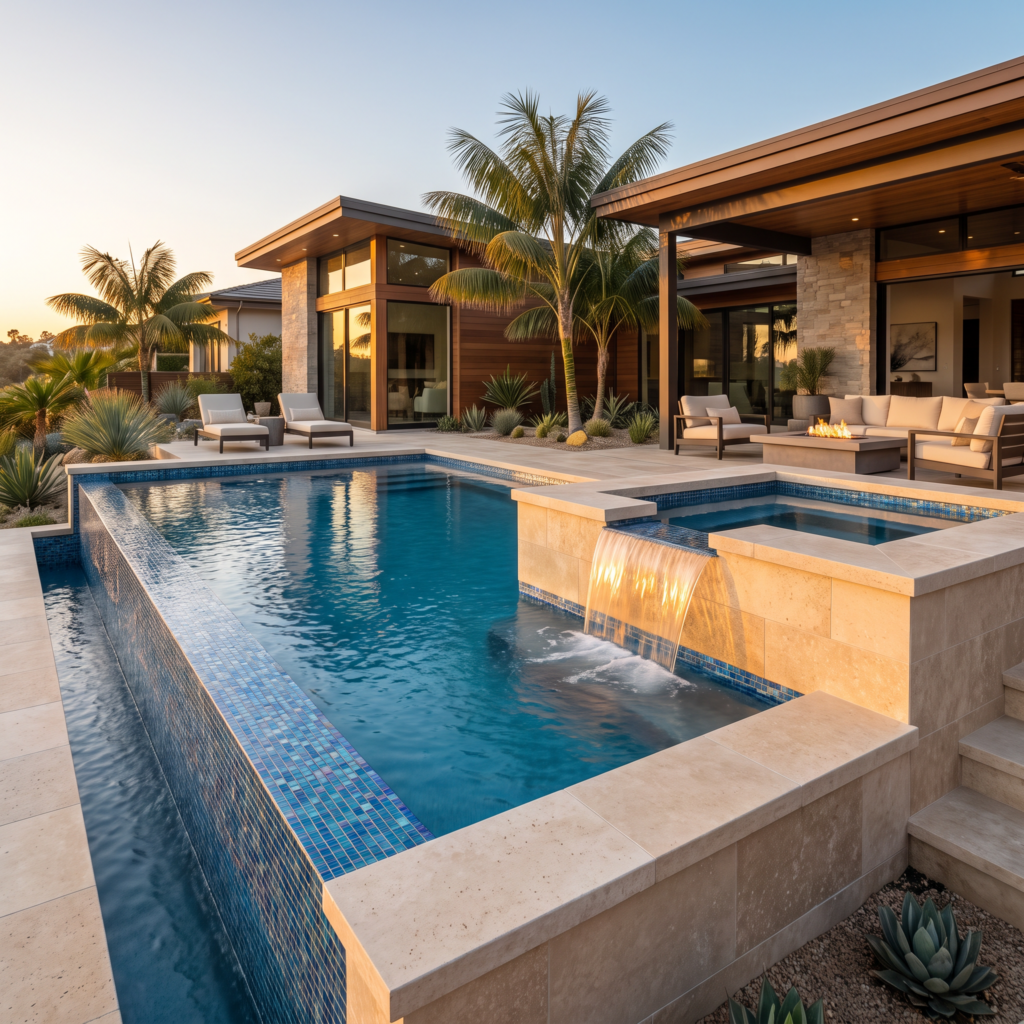
Materials are what people actually touch and see every day. Decking, coping, waterline tile, and interior finish work together as a palette. A pebble interior in a deep tone reads like a natural lagoon. A lighter plaster with glass tile reads bright and coastal.
Coping is the detail most people underestimate. It frames the entire pool, and the difference between a thin modern edge and a rolled bullnose changes the whole character of the water. Deck material carries the rest of the tone, whether that is large-format porcelain, honed travertine, or a paver in a warm neutral. Browsing completed projects is often the fastest way to understand how these choices feel in real light.
The Final Tile Is the Last Two Percent
Tile gets chosen near the end because it responds to everything already decided. It should complement the deck, the coping, the home, and the light the yard actually receives. A tile that looks stunning in a showroom can read cold under San Diego afternoon sun, so samples get viewed on site whenever possible.
By the time tile is selected, the design has been through the land, the zones, the architecture, the rendering, and the palette. That order is what keeps the finished pool feeling cohesive rather than assembled. Nothing in it is rushed, and nothing in it is guessed.
If you are thinking about what your own backyard could become, we are happy to walk you through the process and show you the design before you commit to anything. Reach out at everlastingpoolsandlandscape.com or call (858) 250-3233 whenever you are ready to start the conversation.
Follow our work in Google Search.