
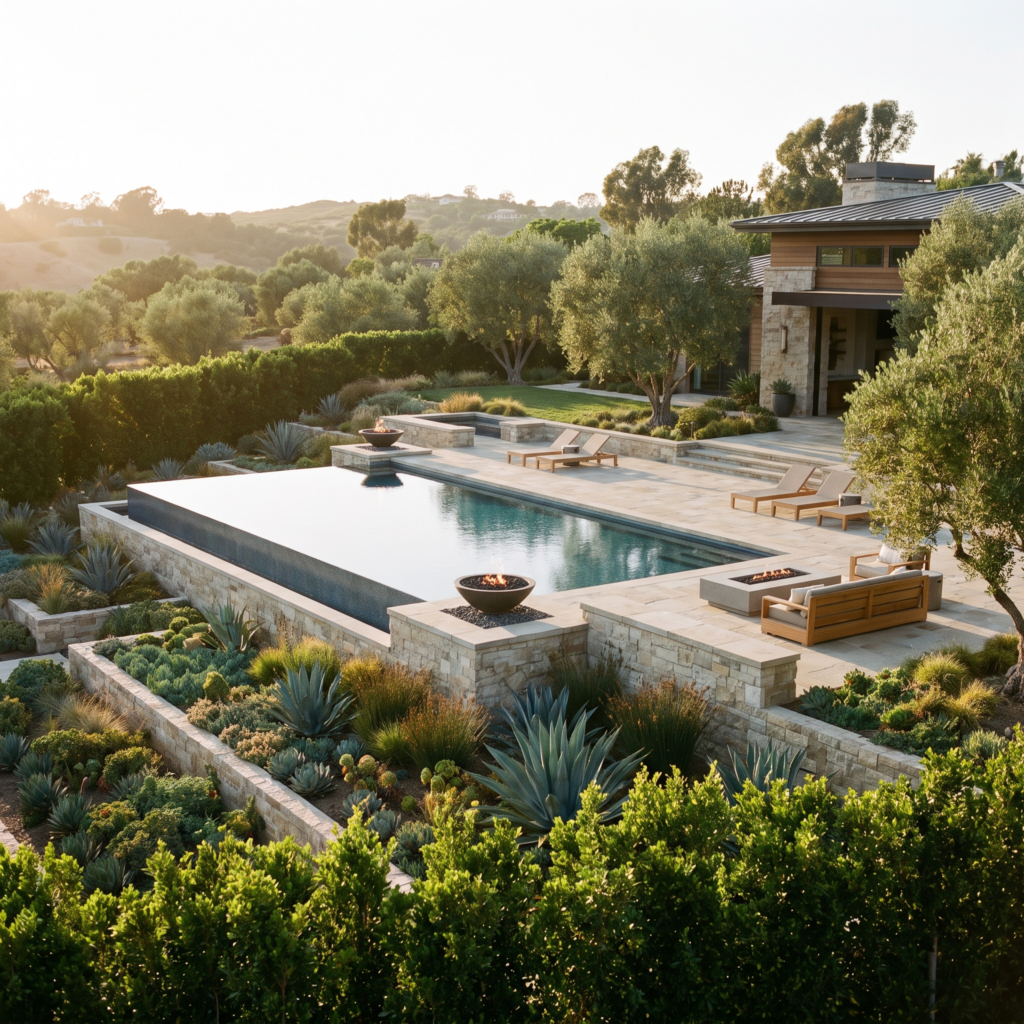
Landscape Design in Rancho Santa Fe: Designing for Acreage and Privacy
Landscape Design in Rancho Santa Fe: Designing for Acreage and Privacy
An acre changes the problem. On a standard San Diego lot, landscape design is about making a modest space feel larger and more considered. On a Rancho Santa Fe estate, the space is already there. The work is giving it structure, so that scale reads as intentional rather than empty.
That distinction drives almost every decision on a large inland property. Here is how we approach it.
Acreage Changes the Design Problem
Large properties fail in a predictable way. The area near the house gets designed carefully, and everything beyond it trails off into unresolved ground. The result is a beautiful terrace surrounded by a field.
The fix is to treat the property as a sequence of destinations rather than one large yard. A dining terrace near the kitchen. A pool and lounge zone a short walk away. A fire area further out, sited for the evening view. Each one is a place to go, and the space between them becomes a journey rather than leftover ground.
As a result, the design question on acreage is not what to fill the space with. It is where you want people to end up, and what the walk there should feel like.
Privacy on a Large Lot Is Built, Not Assumed
Homeowners often assume that acreage delivers privacy automatically. It usually does not. Rancho Santa Fe properties frequently sit on rolling terrain, which means neighboring homes look down into yards that feel secluded at ground level.
Real privacy comes from layered planting at the right elevations, from grade changes, and from siting structures where they block rather than frame. Mature specimen trees do more here than fencing ever will. For a fuller treatment of the subject, see our piece on designing for privacy in a San Diego backyard.
Water, Soil, and Inland Heat
Rancho Santa Fe runs hotter and drier than the coast, and it is subject to real water restrictions. A planting plan that thrives in Del Mar can struggle here by August.
The answer is not gravel and three plants. Olive, oak, and pepper trees, ornamental grasses, salvias, and structured Mediterranean planting all handle inland heat while still reading as lush. Well designed irrigation zoning matters just as much, because a large property watered as a single zone wastes enormous volume and still leaves dry patches.
In addition, fire safety planning is genuine on inland acreage. Defensible space requirements shape what can be planted near structures, and those requirements are easier to design around than to retrofit.
Structure: Giving a Large Property Its Bones
Estates need architecture in the landscape. Low walls, stone terraces, a long allee of trees, an axis that runs from the back door to something worth walking toward. These elements give the eye a framework, and without them even expensive planting looks unresolved.
Materials should follow the house. A Spanish Colonial home wants different stone and different proportions than a coastal modern one. When the hardscape reads as an extension of the architecture, the property feels designed rather than decorated. Our Rancho Santa Fe project shows how that logic plays out on a real estate property.
Lighting Across Distance
Lighting is where large properties either come alive at night or disappear. The instinct is to light the patio and stop. However, on acreage the more powerful move is to light the far edges, because that is what gives the property depth after dark.
Uplighting on mature trees at the boundary, low path lighting along the walk between zones, and a warm glow at the furthest destination all pull the eye outward. The property then reads at its full size in the evening, which is when most people are home to see it.
Planning Landscape Design on an Estate Property
Large properties reward phasing. Not every estate is built in a single season, and there is no reason it has to be. What matters is that the master plan exists first, so that phase one does not have to be undone to make room for phase three.
That plan is also what makes budgeting honest. Once the whole property is drawn, the cost of each zone is clear, and you can decide what happens now and what happens later with real numbers instead of estimates. If you are weighing who to work with, our guide to choosing a landscape designer in San Diego lays out what to look for.
If you own acreage in Rancho Santa Fe and want to see what the whole property could become, we would be glad to walk it with you. Visit everlastingpl.com or call (858) 250-3233.
Follow our work in Google Search.