
What Separates a Luxury Pool From a Standard Pool in San Diego
What Separates a Luxury Pool From a Standard Pool in San Diego
The Difference Is Rarely the Thing You Are Looking At
Two pools can be the same size, hold the same water and cost twice as much apart. Homeowners often assume the gap comes down to finish upgrades, a nicer tile or a bigger spa. In practice, most of the difference sits in decisions made before anyone breaks ground, and in structure the finished pool will never show you.
A luxury pool San Diego homeowners still love ten years later is not defined by how expensive it looked on day one. It is defined by proportion, by how it sits in the yard, and by whether the details hold up. Below is what actually separates the two tiers.
Engineering You Will Never See
Standard pools are usually built to a repeatable template. The shell depth, the steel schedule and the plumbing runs follow a default that works on a flat, forgiving lot. That approach is fine when the site cooperates.
San Diego sites frequently do not cooperate. Expansive soil, fill, hillside cuts and coastal water tables all demand engineering specific to the property. A luxury build starts with soils work and a structural design matched to that report, which can mean deeper footings, heavier steel or caissons on a slope. In addition, plumbing is oversized and run in larger diameter lines with sweeping turns rather than tight elbows, which lowers friction loss and lets the pool run quietly and efficiently for decades. None of this is visible. All of it determines whether the shell stays true.
The Edge Detail Does More Work Than Anything Else
If you compare photographs of expensive pools, the edge is almost always what your eye responds to. A standard pool uses a cantilevered concrete edge or a basic bullnose coping, set at a height that reads as a lip around a container of water.
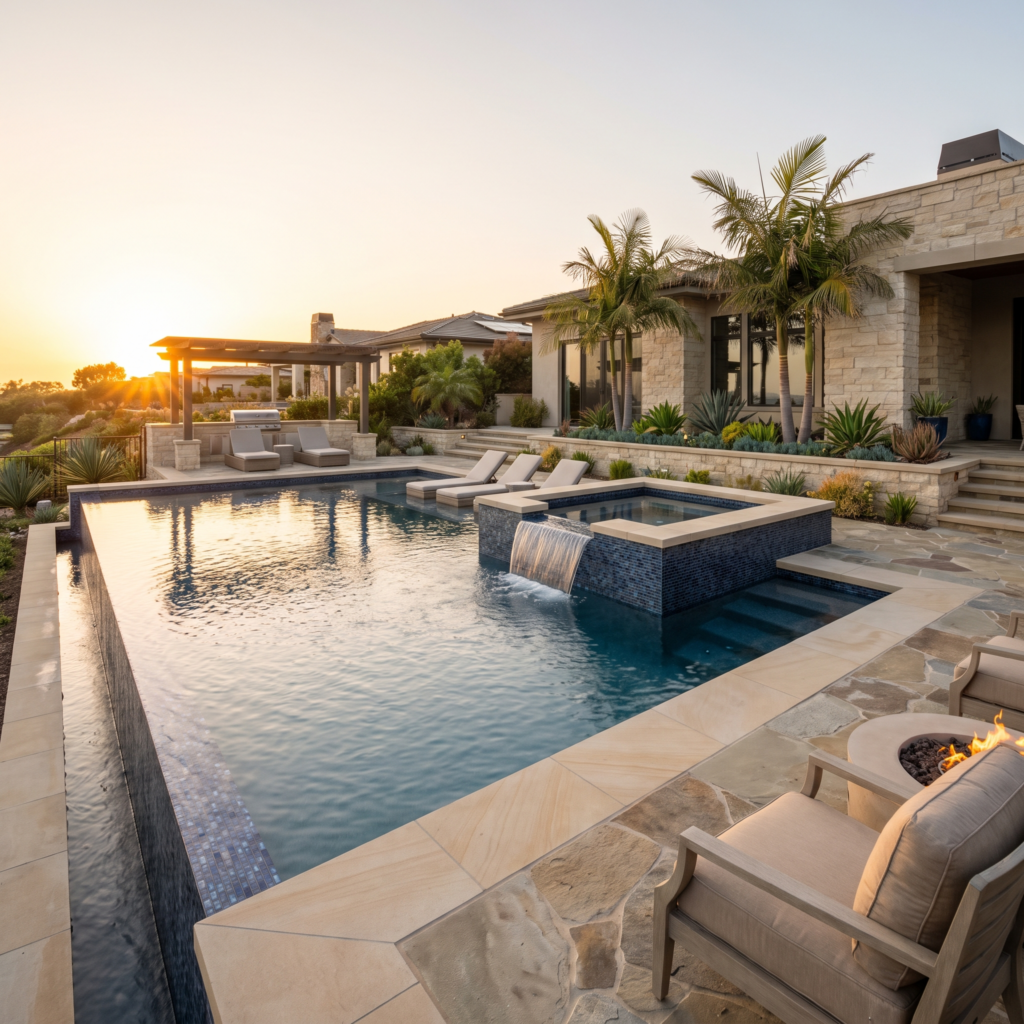
Luxury design treats the edge as the primary architectural move. A perimeter overflow brings the water flush with the deck so the pool reads as a still plane. A vanishing edge disappears the far wall into the landscape beyond. A raised bond beam with a sheer descent creates sound and movement. Each choice changes the entire character of the yard, and each carries real cost, because the tolerances tighten dramatically. A perimeter overflow has to be level within a fraction of an inch across its whole run, which is a construction problem, not a finish problem. Our breakdown of pool water features goes deeper on how these elements behave.
Materials That Age Instead of Wear
Standard plaster is quoted in white or a basic gray and typically shows mottling and wear inside seven to ten years. Premium pebble and quartz finishes cost more upfront and hold their color considerably longer, which changes the math over the life of the pool.
Tile tells a similar story. A stock six inch waterline tile is functional. Hand glazed glass mosaic shifts color as light moves across it through the day, and that shift is a large part of why certain pools look expensive in every photograph. Decking follows the same logic, where thin pavers on sand settle unevenly while full thickness stone or porcelain on a proper base stays flat. As a result, the luxury tier costs more at purchase and less across twenty years of ownership.
Equipment, Automation and Water Quality
Equipment is where standard pools most often economize, because the buyer cannot see it during a walkthrough. Undersized pumps, minimum filters and basic chlorination all pass inspection and all make ownership worse.
A well specified pool uses a variable speed pump sized to the plumbing, an oversized filter that extends cleaning intervals, and sanitation matched to how the family actually swims. Automation ties heating, lighting and water features to your phone so the spa is ready when you arrive home. However, the point is not gadgetry. The point is that the pool becomes effortless, and a pool that is effortless is a pool that gets used.
The Process Behind the Product
The last difference is the one homeowners feel most. A standard pool is often sold from a catalog, signed quickly, and figured out in the field. A luxury pool is designed first, modeled in 3D, priced against a real plan, and built by one team that owns both the design and the construction.
That matters because the expensive mistakes in a backyard are design mistakes, not construction mistakes. A pool placed two feet wrong, or sized without regard for the patio around it, cannot be fixed with better tile. We cover why we keep both sides of that under one roof in our piece on design and build together.
Custom pool projects with us generally begin around $100,000, and the figure reflects engineering, edge work, materials and process rather than square footage alone. If you are weighing two very different proposals and want help reading what is actually in them, we are glad to talk. Reach us at everlastingpl.com or (858) 250-3233.
Follow our work in Google Search.