
Pool Water Features Explained: Sheer Descents, Scuppers, and Bubblers
Pool Water Features Explained: Sheer Descents, Scuppers, and Bubblers
Water is the element that makes a backyard feel finished. Not the size of the pool, and not the price of the tile. Movement. The sound of water falling, the light it catches at dusk, and the way it softens a space. For most homeowners that feeling comes from a water feature, even if they never learned the names for them.
Three show up most often in luxury San Diego backyards: sheer descents, scuppers, and bubblers. They look different, sound different, and belong in different places. Here is how to tell them apart, and how to decide which one belongs in your design.
What a Water Feature Actually Does for a Backyard
A water feature does three jobs at once. It adds sound, which masks traffic and neighbors and makes a yard feel private. It adds movement, so the pool reads as alive rather than still. In addition, it gives the eye somewhere to land, which is what turns a rectangle of water into a designed space.
Sound matters more than most homeowners expect. A backyard on a tight coastal lot feels twice as private once there is water moving in it. However, the wrong feature in the wrong spot creates noise instead of calm. Scale and placement decide which one you get.
Sheer Descents: The Architectural Sheet of Water
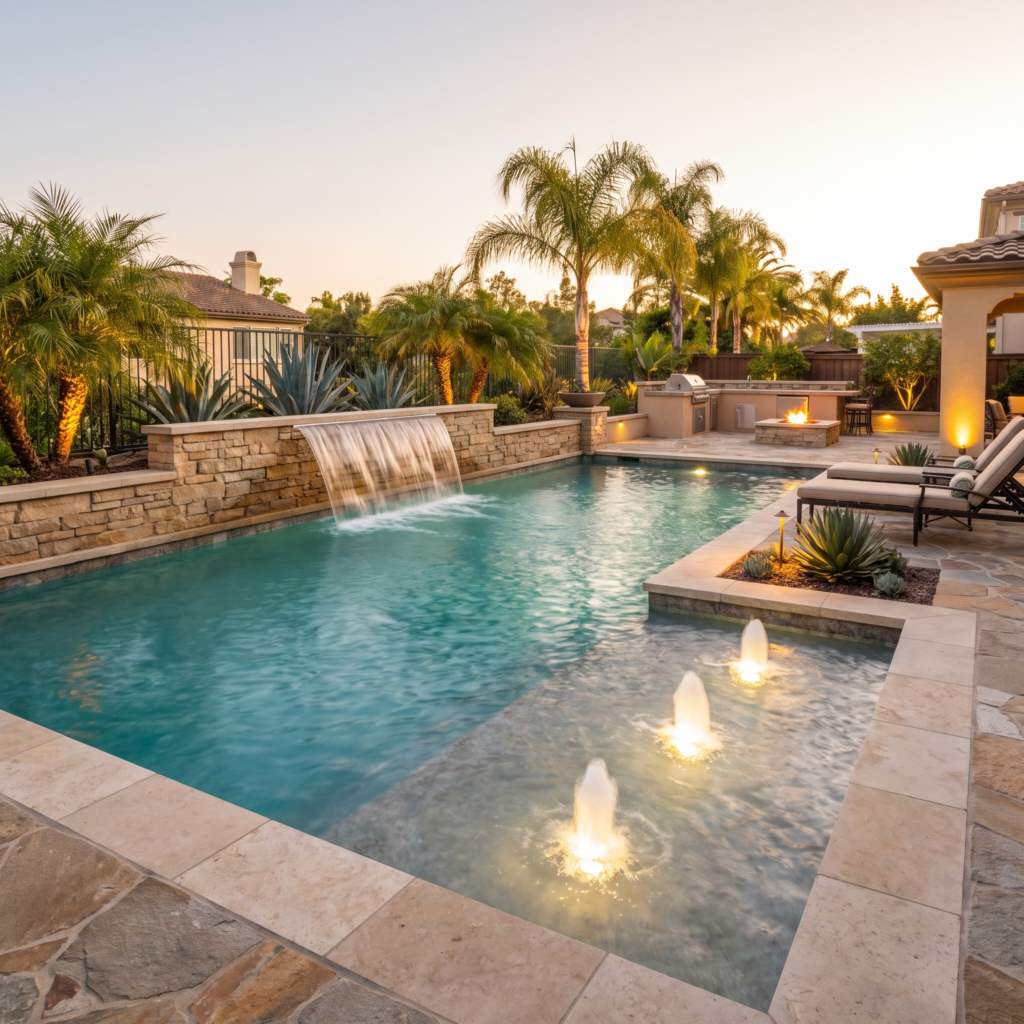
A sheer descent produces a wide, flat sheet of water falling from a raised wall into the pool. It is the most architectural of the three. The line is clean and the effect is dramatic.
Sheer descents work best on raised walls, retaining walls, or the face of a raised spa. They need solid structure behind them and enough drop to keep the sheet intact. Twelve to eighteen inches of fall is a common range, though the right number always depends on the wall.
They are also the loudest of the three, and that is often the point. For example, a yard near a busy street benefits from that volume. A quiet canyon lot usually does not. We tend to pair a sheer descent with a variable speed pump, so the sheet can be dialed down for a quiet dinner and opened up when the family is in the pool.
Scuppers: Small Spouts With a Big Presence
A scupper is a spout, usually set into a wall or a raised bond beam, that sends a narrow stream of water into the pool. Where a sheer descent is one wide gesture, scuppers are rhythm. Three or five of them spaced across a wall create repetition, and repetition is what makes a wall feel intentional.
Material choice carries the design here. A scupper can be a simple stainless slot, a cast stone bowl, or a custom tile channel that continues the waterline detail. As a result, scuppers are the feature most often used to tie the pool back to the architecture of the house.
They are quieter than sheer descents and easier to fit into a modest wall. For a backyard where the pool sits close to a dining area, that restraint is usually the right call.
Bubblers: Movement Without Noise
A bubbler sits in the floor of a tanning ledge or Baja shelf and pushes a low, rolling column of water upward. It is the quietest of the three and the most playful. Children gravitate to them. Adults notice them at sunset, when the moving water catches low light.
The same shelf is also where in-pool daybeds sit, and that furniture has its own depth and sizing requirements. Our guide to building a tanning shelf that actually holds in-pool daybeds covers the numbers to get right before the shell is poured.
Because a bubbler lives in shallow water, it has to be planned with the ledge itself. Placement, spacing, and the depth of the shelf all change how the water behaves. In addition, bubblers pair naturally with a light set directly beneath them, which is one of the more striking effects available after dark. Our guide to pool lighting design covers how that layering works.
How to Choose the Right Combination
Most well composed pools use one primary feature and one supporting feature. A sheer descent on a raised wall with bubblers on the ledge is a common and balanced pairing. So is a run of scuppers with a single bubbler in the shallow end.
What rarely works is three loud features competing across one small yard. Restraint reads as luxury. Excess reads as a showroom. When we plan water alongside fire and seating, the goal is a sequence rather than a pile of features, and we walk through that logic in our piece on layering water, fire, and seating.
Start with how the yard will actually be used. A family that swims daily wants a ledge and bubblers. A couple that hosts wants a wall that sounds beautiful from the dining table.
Plan Water Features Before Construction Begins
Every one of these features is plumbing, structure, and electrical before it is aesthetics. Retrofitting a sheer descent into a finished wall is expensive and rarely clean. For that reason, water features belong in the design phase rather than the change order phase.
This is where seeing the design first changes the conversation. In a 3D rendering you can see the height of the wall, the width of the sheet, and how the whole thing looks from the kitchen window, all before a single line is trenched.
If you are planning a pool in San Diego and want to talk through which water features fit your space, we would be glad to walk the yard with you. Visit everlastingpl.com or call (858) 250-3233.
Follow our work in Google Search.