
How Lighting Design Transforms a San Diego Backyard After Dark
How Lighting Design Transforms a San Diego Backyard After Dark
A backyard is finished twice. It is finished once in daylight, when the stone, the water, and the planting do the work. Then it is finished again at night, when almost none of that is visible and light decides what you see. Most homeowners plan carefully for the first version and leave the second to chance. As a result, a beautiful space quietly closes at sunset. Backyard lighting design in San Diego is what keeps the yard open, and it is one of the highest return decisions in the whole project.
Why Most Backyards Stop Working at Sunset
San Diego evenings are the best part of the day for most of the year. The air cools, the glare softens, and the yard becomes comfortable. However, a backyard with only a few floodlights on the back of the house does not feel inviting after dark. It feels exposed. The light comes from one direction, flattens everything it touches, and leaves the far half of the property in shadow.
The result is predictable. Families use the yard for an hour after dinner and then move back inside. The pool sits unused. The outdoor kitchen becomes a place to store things. For a space built to hold gatherings and quiet evenings, that is a significant amount of value left on the table.
Lighting Is a Design Layer, Not an Add On
Lighting is often treated as a late decision, something to sort out once the hardscape is set and the budget is nearly spent. That sequencing is the problem. Conduit runs under paving. Transformers need a home. Fixtures inside a pool shell have to be placed before the shell is finished. Every one of those choices becomes expensive or impossible to change later.
For this reason, we plan lighting alongside the layout rather than after it. When the lighting plan and the design develop together, fixtures disappear into the architecture. You see warm pools of light on stone and foliage, not a row of fittings staring back at you. That is the difference between a yard that looks lit and a yard that looks designed.
The Four Layers That Make a Backyard Read at Night
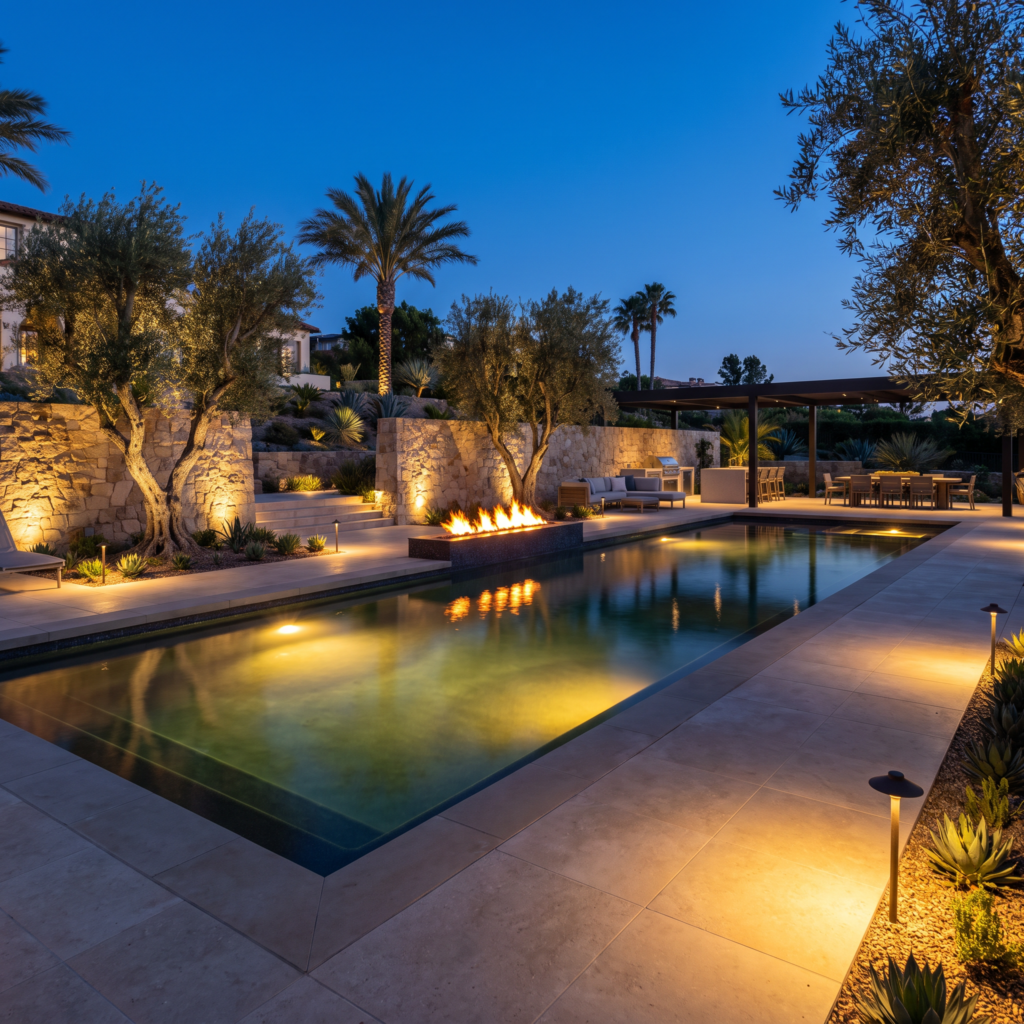
Refined lighting is layered. Ambient light sets the overall level and usually comes from soft downlight in trees or under structures. Task light covers the places where people do things, such as a grill, a bar top, or a set of stairs. Accent light is what creates depth, washing a wall, grazing a stone face, or lifting a mature tree out of the dark. Finally, feature light gives the yard its focal points, including water, fire, and the pool itself.
When all four layers are present, the eye travels. It moves from the patio to a lit olive tree to a glowing wall at the back fence, and the property feels larger than it does in daylight. When only one layer is present, the yard feels like a room with a single bulb in it. Our full explanation of how to use outdoor lighting in backyard design covers this layering in more detail.
What San Diego Conditions Change
Coastal properties are hard on fixtures. Salt air corrodes cheap housings within a season or two, so brass and marine grade stainless are worth the difference on any site within a few miles of the water. In addition, coastal lots are often tight, which means fixture aiming matters as much to your neighbors as it does to you.
Inland properties bring a different set of conditions. Lots are larger, slopes are more common, and mature trees give you the height to light from above rather than only from the ground. Dark sky considerations also carry more weight inland, where ambient light is lower and a poorly aimed fixture is visible from a long distance. In both cases, the right answer comes from the site, not from a catalog.
The Details That Separate Refined From Bright
Color temperature is the first thing most people get wrong. Cool white light makes stone look grey and planting look artificial. Warm light in the 2700K range flatters natural material and skin, which is why every good hospitality property uses it. Consistency matters too, so the pool, the landscape, and the structures should share one temperature rather than three.
Beyond that, the best lighting hides its source. Fixtures tuck behind planting, recess into risers, or mount high enough in a tree that you never look directly at the lamp. Dimming is the final piece, because the level you want for a dinner party is not the level you want on a quiet Tuesday. Our guide to pool lighting design goes deeper on the water side of this, and shade design handles the daytime half of the same question.
If you are planning a backyard and lighting is still an open question, it is worth addressing early while the layout is still on paper. You can see the whole plan, lighting included, in a 3D rendering before anything is built. Reach out at everlastingpl.com or call (858) 250-3233 when you are ready to talk through your property.
Follow our work in Google Search.