
How to Choose Plants That Actually Thrive in a San Diego Backyard
How to Choose Plants That Actually Thrive in a San Diego Backyard
Planting is the part of a backyard that people notice last and feel first. Hardscape gives a space its structure. Plants give it life, softness, privacy, and scent. Yet planting is also where the most money gets wasted, because a plant that looks beautiful in a nursery container may struggle in the specific corner of a San Diego yard where it lands.
Choosing well is less about finding tough plants and more about matching plants to conditions. Here is how we approach it.
Start With Your Microclimate, Not a Plant List
San Diego is not one climate. A yard in Del Mar receives marine air, cool nights, and salt exposure. A yard in Poway, twenty minutes inland, can run fifteen degrees hotter in August with almost no coastal moisture. The same plant behaves differently in each.
Before selecting anything, map the yard. Note where morning sun lands, where afternoon heat concentrates, where wind funnels between structures, and where water naturally collects. Most planting failures trace back to a plant placed in a spot that never suited it.
In addition, pay attention to reflected heat. A bed against a west-facing stucco wall behaves like a desert regardless of what the rest of the yard is doing.
Drought Tolerant Does Not Mean Sparse
There is a persistent assumption that low-water planting means gravel and a few agaves. That is one interpretation, and it is rarely the most beautiful one.
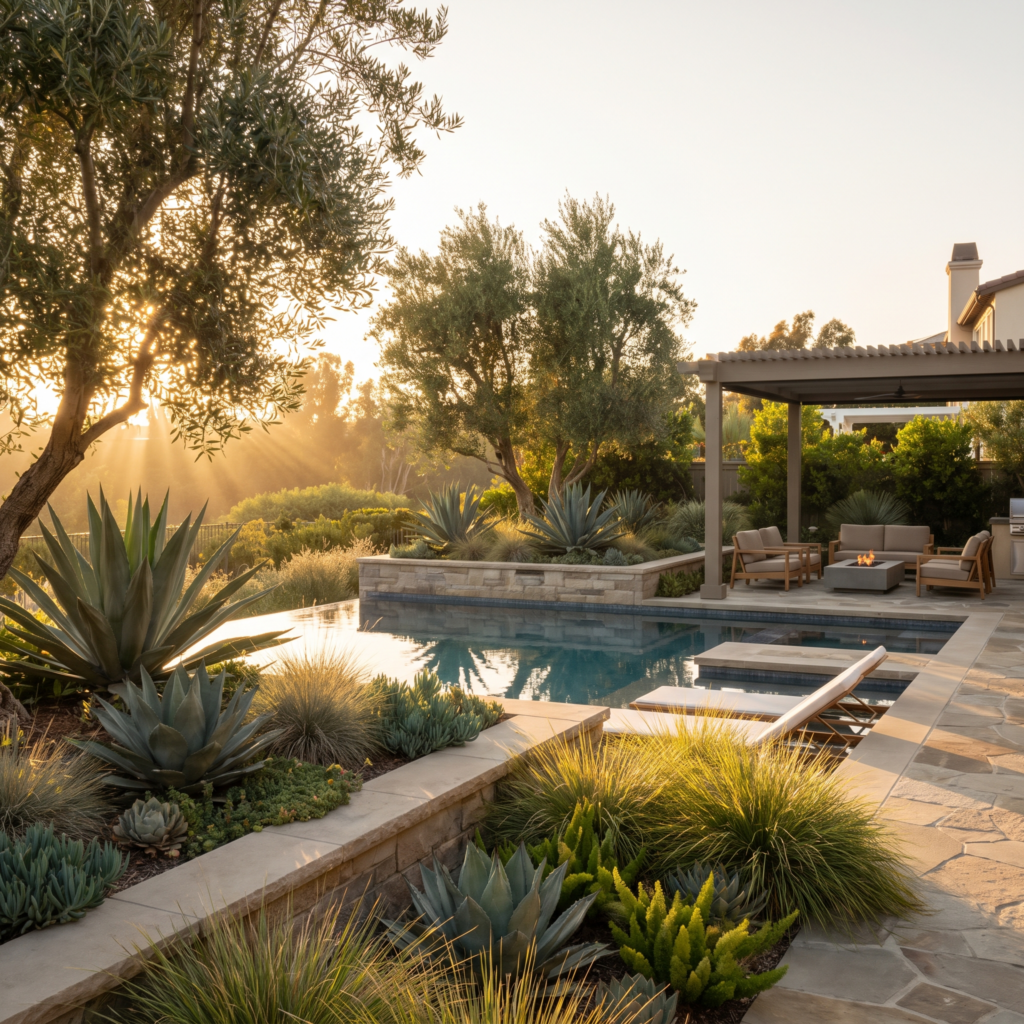
Mediterranean planting palettes give San Diego yards abundance without heavy irrigation. Olive trees, rosemary, westringia, lavender, teucrium, and dwarf myrtle create fullness and structure while using a fraction of the water a lawn requires. For example, a bed of layered rosemary, kangaroo paw, and ornamental grasses reads as lush from six feet away while surviving on deep watering twice a month once established.
The goal is a planting plan that looks generous in year three, not just in the first month.
The Plants That Perform Year After Year
Certain species earn their place in almost every project we design. Olive trees provide silvery canopy and hold their shape for decades. Podocarpus makes a clean architectural hedge that handles both coastal and inland conditions. Agave attenuata offers sculptural form without the sharp edges of most agaves.
For color, kangaroo paw, salvia, and bougainvillea deliver long bloom cycles with minimal fuss. For texture, dymondia works as a walkable ground cover between pavers, and dwarf mondo grass softens edges beautifully.
Meanwhile, a few common choices deserve caution. Queen palms drop constantly. Ficus roots damage hardscape and plumbing. Bamboo spreads further than almost anyone expects. Attractive plants become expensive problems when the wrong one is planted near a pool shell or a paver field.
Planting Around a Pool
Pool-adjacent planting has its own rules. Anything that sheds heavily creates daily maintenance and shortens filter life. Anything with aggressive roots threatens the shell and the deck.
As a result, we favor clean, low-litter species near water: agave, dianella, blue chalk sticks, dwarf olive, and horsetail reed in contained planters. Set larger trees back far enough that their mature canopy does not overhang the water surface. However, do not push all greenery to the perimeter. A pool with no planting near it feels institutional rather than resort-like.
Planting also does quiet work for privacy. Our guide to designing for privacy in a San Diego backyard covers how to layer greenery with built elements so a yard feels enclosed without feeling closed in.
Layering for Structure and Softness
Good planting design works in three tiers. Canopy trees establish scale and shade. Mid-height shrubs and hedges create form and screening. Ground covers and low perennials finish edges and connect the composition.
Skipping a tier is the most common design mistake. A yard with only trees and ground cover feels thin. A yard with only shrubs feels flat. Each layer needs to be intentional, and each needs room to reach mature size without crowding the next.
Restraint matters here. Repeating six well-chosen species across a yard reads far more refined than planting twenty. Repetition is what makes a landscape look designed rather than collected. The same principle applies to hardscape, as our guide to choosing the right materials for a San Diego backyard explains.
Design the Planting Plan Before You Plant
Planting deserves the same planning as a pool or a kitchen. Mature sizes, water zones, bloom timing, and sight lines should all be resolved on paper before the first container arrives.
A yard planned this way looks intentional in every season rather than only in spring. Our guide to year-round backyard design goes deeper on that idea.
If you are planning a backyard and want the planting to feel as considered as the architecture, we would enjoy talking it through with you. Reach us at everlastingpl.com or (858) 250-3233.
Follow our work in Google Search.