
In-Pool Daybeds: How to Build a Tanning Shelf That Actually Holds Them
In-Pool Daybeds: How to Build a Tanning Shelf That Actually Holds Them
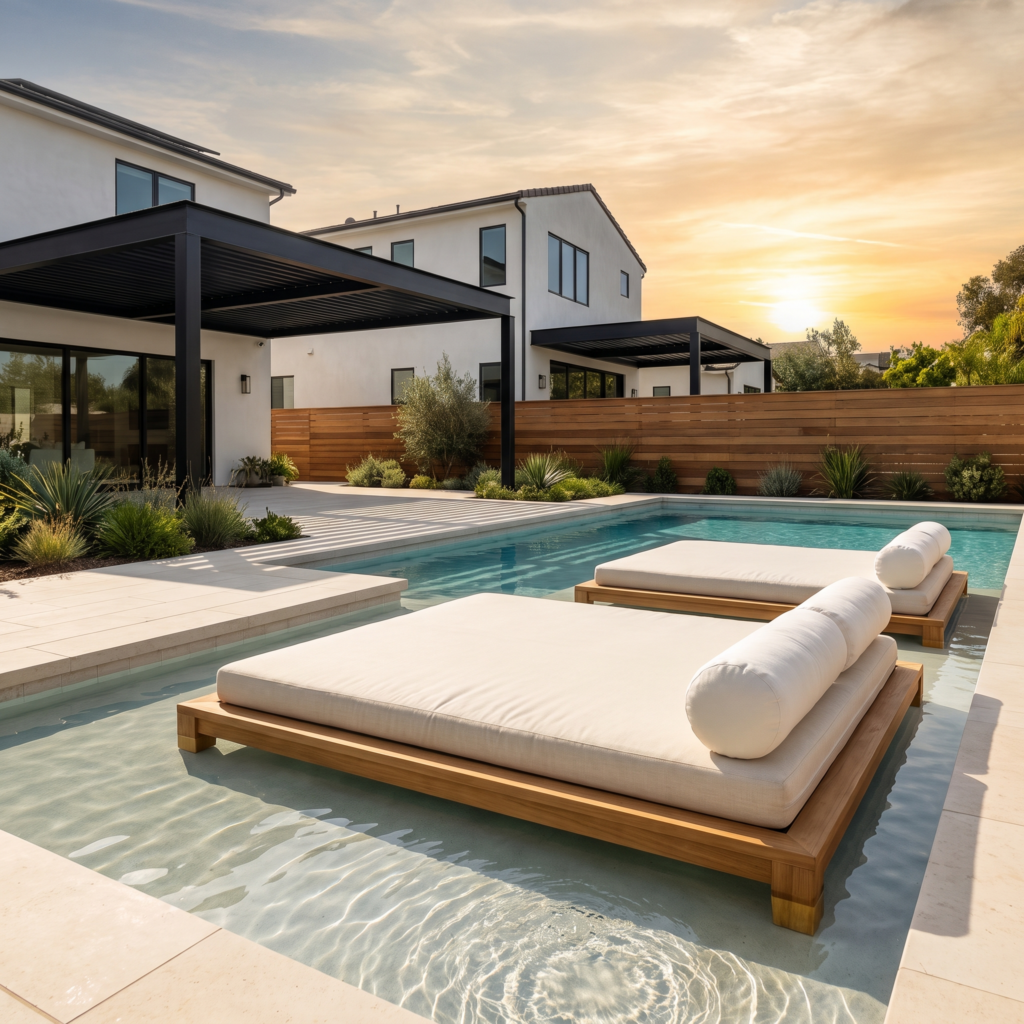
In-pool daybeds have quietly become the most requested feature in San Diego backyard design. They look effortless in photos. A teak platform, a thick cream cushion, a few inches of water moving underneath. However, the daybed is only half of the equation. The shelf it sits on has to be designed for it, and that decision happens long before anyone shops for furniture.
Most homeowners find this out too late. The pool gets built, the shelf turns out too deep or too small, and the daybed either floats, wobbles, or never fits at all. Here is what to get right while the design is still on paper.
Why In-Pool Daybeds Took Over
A traditional tanning ledge was designed for feet. You sat on the edge, dangled your legs, and cooled off. The in-pool daybed changed the purpose entirely. Suddenly the shallow end became the best seat in the yard.
The appeal is easy to understand. You stay cool without swimming. You can hold a conversation. Children play a few feet away while adults stay comfortable. For example, a family that used to gather around a dining table now gathers at the water. As a result, the shelf stops being a transition space and becomes the destination.
It also photographs beautifully, which is part of why the look spread so quickly. But the reason it lasts has nothing to do with photos. It is simply the most comfortable place to be on a warm afternoon.
Depth Is the Number One Thing People Get Wrong
Build the shell 9 to 12 inches deep. Because water typically sits about 3 inches below the ledge surface, that gives you roughly 6 to 9 inches of actual water on the shelf. That range is the sweet spot.
Go deeper and the physics turn against you. Past roughly 12 inches, most in-pool furniture begins to float and shift. Past 15 inches, the shelf stops working for small children and stops working for furniture at the same time. Furthermore, a shelf that deep loses the shallow, reflective look that made you want one in the first place.
Go shallower and you get the opposite problem. Under about 5 inches, the water warms fast and the cooling effect disappears. In addition, the shelf reads as a puddle rather than a design feature.
Some daybeds are built for deeper water and are weighted accordingly. If you have already chosen a specific piece, bring the specification to your designer before the shell is shot. The furniture should inform the shelf, not the other way around.
Size It for the Furniture, Not for the Drawing
Depth gets most of the attention. Size is where the real disappointment happens.
A single full-size daybed needs roughly 6 feet of length and 3 feet of width. To place two side by side with room to walk between and around them, plan on a shelf close to 6 feet by 6 feet. Anything tighter and the furniture fills the entire shelf, which looks crowded and leaves nowhere to stand.
The mistake we see most often is a shelf sized to look balanced on a plan drawing. It reads beautifully on paper. Then the furniture arrives and there is no usable space left. Therefore, we always place the actual furniture footprint into the design before the shelf dimension is locked.
It is worth understanding how a shelf differs from other shallow features as well. Our guide to Baja shelves, tanning ledges, and sundecks covers where each one belongs in a backyard.
The Details You Cannot Add Later
Two items have to be built into the shell. Neither can be retrofitted without breaking concrete.
The first is circulation. A shallow shelf sits outside the pool’s main flow, so the water there warms faster and clears more slowly. A dedicated return line keeps it moving. Without one, the shelf can turn cloudy in summer while the rest of the pool stays perfect. Bubblers are a popular addition here as well, and they serve a similar purpose while adding movement and sound. Our overview of pool water features explains how they are plumbed.
The second is an umbrella sleeve. A sleeve set into the shell during the pour gives you shade exactly where you are sitting. It costs very little at that stage. Adding one afterward means cutting into a finished shell, which nobody wants to do.
Materials That Survive a San Diego Summer
Constant sun, chlorinated water, and coastal air are demanding conditions. Teak and powder-coated aluminum both hold up well. Cushions should be marine-grade or solution-dyed acrylic, not standard outdoor fabric.
Coastal properties need more attention than inland ones. Salt air is unforgiving on hardware, so stainless fasteners are worth specifying.
See It Before You Build It
Shelf depth, shelf size, and furniture placement are difficult to picture from a flat plan. That is why every Everlasting project includes a full 3D design before anything is signed. You see the daybeds in place, at the right scale, in your own yard. Consequently, the decisions get made when they are still easy to change.
If you are planning a pool or rethinking one you already have, we would be glad to walk your space and show you what the shelf could become. You can see more about how our 3D renderings work, or reach us at (858) 250-3233.
Follow our work in Google Search.